
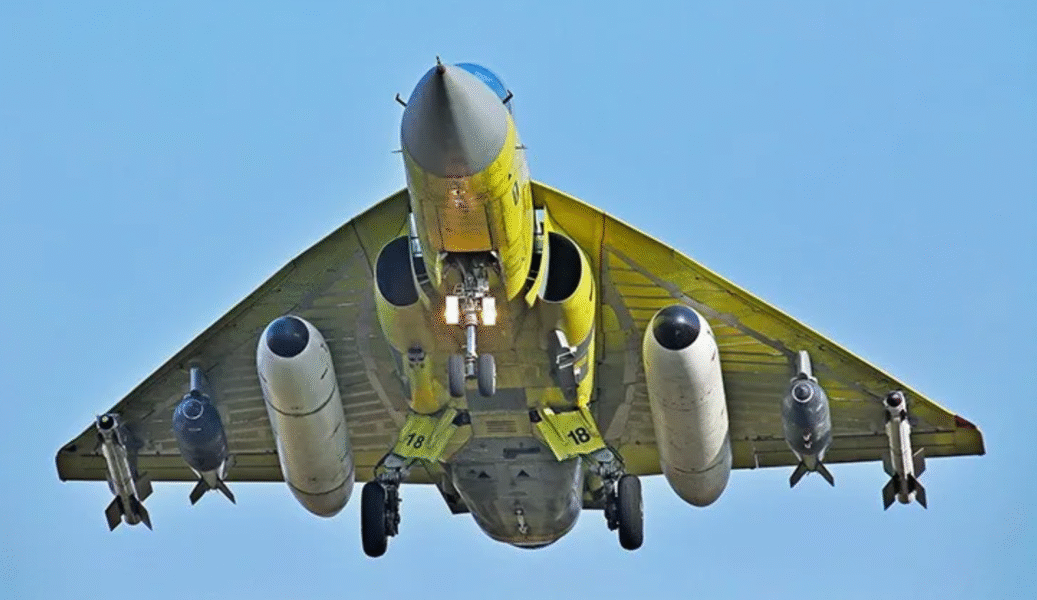
The HAL Tejas is more than just a fighter jet. It is a symbol of India’s five-decade-long ambition to achieve self-reliance in defence technology.
As the smallest and lightest fighter jet in its class, the Tejas represents a significant technological milestone for the Indian aerospace industry.
This evaluation will go beyond the patriotic fervor and the often-harsh criticism. We will provide a balanced, technical analysis of the aircraft’s strengths, weaknesses, and its place in the modern combat aviation landscape.
From its agile design to its protracted development, we will dissect what makes the Tejas a remarkable achievement and where it faces significant challenges.
- Historical Context: A Long Road to the Sky
- Design Philosophy: Light, Agile, and Unstable
- Avionics and Sensors: A Glass Cockpit Warrior
- Armament and Payload: A Well-Armed Point Defender
- Performance and Flight Characteristics
- The Tejas Mk1A Evolution: Addressing the Shortcomings
- Strengths and Advantages of Tejas
- Weaknesses and Challenges of Tejas
- The Verdict: A Qualified Success with a Promising Future
Historical Context: A Long Road to the Sky
The Tejas story begins in the 1980s with the Light Combat Aircraft (LCA) program. Its primary goal was to replace the aging MiG-21 fleet of the Indian Air Force (IAF).
The program faced immense challenges from the start. The 1998 nuclear tests led to international sanctions, crippling access to key technologies, especially from the United States Political leadership and Command.
This forced Indian scientists and engineers to develop complex systems indigenously, leading to significant delays. The first technology demonstrator took flight in 2001, but achieving Final Operational Clearance (FOC) took until 2019.
This long gestation period meant the aircraft entered service decades after it was initially conceived, a common challenge for indigenous defense projects worldwide.
Design Philosophy: Light, Agile, and Unstable
The Tejas was designed with a focus on high agility and a small visual signature. Its compact, tailless delta-wing configuration is its most distinctive feature.
This design provides several advantages. It offers high instantaneous turn rates, excellent high-speed performance, and a large internal volume for fuel and equipment.
A key aspect of its design is that it is inherently aerodynamically unstable. This might sound like a flaw, but it is a deliberate feature of modern fighter jets.
This instability is managed by a digital Fly-By-Wire (FBW) flight control system. The FBW computer makes thousands of corrections per second, making the jet highly responsive and maneuverable.
Avionics and Sensors: A Glass Cockpit Warrior
The Tejas features a modern “glass cockpit,” a significant leap from the analog dials of the MiG-21. The pilot interacts primarily with digital multi-function displays (MFDs).
The core of its sensor suite is an Israeli-made Elta EL/M-2032 multi-mode fire-control radar in the Mk1 variant. This provides decent air-to-air and air-to-ground tracking capabilities.
The more advanced Tejas Mk1A, however, is a game-changer. It will be equipped with the more powerful Elta EL/M-2052 Active Electronically Scanned Array (AESA) radar.
An AESA radar offers greater range, superior tracking of multiple targets, better resistance to jamming, and high-resolution ground mapping. This brings the Tejas in line with 4.5-generation fighters.
The aircraft also features an internally mounted Infrared Search and Track (IRST) system and is equipped with advanced electronic warfare (EW) suites for self-protection.
Armament and Payload: A Well-Armed Point Defender
The Tejas is a versatile platform capable of carrying a wide array of modern weapons. Its payload is comparable to other light combat aircraft in its class.
For air-to-air combat, it can carry beyond-visual-range (BVR) missiles like the Derby and the indigenous Astra. For close-quarters dogfighting, it is equipped with R-73 short-range infrared-guided missiles.
In the air-to-ground role, the Tejas can deploy precision-guided munitions (PGMs), laser-guided bombs, and conventional bombs. It can also carry anti-ship missiles like the Sea Eagle for maritime strikes.
The aircraft has eight hardpoints for carrying this ordnance. While its payload capacity is less than heavyweights like the Su-30MKI, it is sufficient for its intended role as a point-defence interceptor and multi-role fighter.
Performance and Flight Characteristics
Powered by a single General Electric F404-GE-IN20 turbofan engine, the Tejas delivers adequate thrust for its light airframe.
Its performance is characterized by excellent low-speed handling and high agility. Pilots who have flown it often praise its responsive controls and ease of handling in the air.
However, the aircraft is not without its performance trade-offs. The current engine, while reliable, does not provide the thrust-to-weight ratio of more powerful competitors.
This can impact its rate of climb and sustained turn performance at high altitudes. The upcoming Tejas Mk2, with the more powerful GE F414 engine, is designed to address this limitation directly.
The Tejas Mk1A Evolution: Addressing the Shortcomings
The Tejas Mk1A is not just an incremental upgrade; it is a critical evolution that addresses several key criticisms of the initial Mk1 version.
The integration of the AESA radar, as mentioned, is the most significant upgrade. It dramatically enhances the jet’s situational awareness and combat effectiveness.
Other major improvements include a superior Electronic Warfare (EW) suite, a new external refueling probe for longer range, and a more modern and maintainable avionics architecture.
Perhaps most importantly for the IAF, the Mk1A incorporates improvements in serviceability and maintenance. This aims to increase the aircraft’s availability rate, a crucial metric for operational readiness.
Strengths and Advantages of Tejas
- High Agility: Its delta-wing design and FBW system make it a nimble dogfighter.
- Modern Avionics: The glass cockpit and AESA radar (on Mk1A) place it firmly in the 4.5-generation category.
- Low Radar Cross-Section (RCS): Its small size and use of composites give it a smaller radar signature than older fighters.
- Weapons Versatility: It can carry a modern and diverse mix of air-to-air and air-to-ground weapons.
- Strategic Independence: It reduces dependency on foreign suppliers and builds crucial domestic aerospace expertise.
Weaknesses and Challenges of Tejas
- Limited Range and Payload: As a light fighter, its operational range and weapons payload are inherently lower than medium or heavy-weight fighters.
- Delayed Development: The decades-long development cycle meant it entered service with technologies that were no longer cutting-edge.
- Production Rate: HAL has faced challenges in ramping up production to meet the IAF’s demand, leading to slow induction.
- Engine Dependency: It still relies on a foreign-made engine, though the core airframe and systems are indigenous.
- Perception Issues: It has struggled to shake off a public perception of being perpetually “late” and “not enough.”
The Verdict: A Qualified Success with a Promising Future
Labeling the Tejas as either a total failure or an unqualified success is an oversimplification. The truth lies in the middle.
As a technological achievement, the Tejas is a resounding success. India has demonstrated its capability to design, develop, and build a modern, capable fighter jet from the ground up.
As a timely military asset, its story is more complex. The delays have been detrimental. However, the Mk1A variant represents the capable, modern fighter the IAF needed a decade ago.
It is a competent aircraft that will effectively replace the MiG-21 and form the lower end of a high-low mix in the IAF, complementing the heavier Su-30s and Rafales.
The future of the program, with the more capable Tejas Mk2 and the AMCA (Advanced Medium Combat Aircraft), looks bright. The lessons learned from the Tejas program are invaluable for these future projects.
The HAL Tejas is a solid foundation upon which the future of Indian military aviation will be built but still their are question marks on the capability of Hindustan Aeronautic Limited and its supply chain. India is foreseeing Tejas as an export product but availability of Jet engines and the recent crashes have created a doubt among potential customers. Similarly the IAF being the major buyer of Tejas are still not satisfied with the pace of delivery and the performance & quality of the aircraft.