

Harnessing the Power of the Sun
The shift towards renewable energy is no longer a niche trend; it’s a global imperative. At the forefront of this revolution are photovoltaic (PV) solar panels.
These silent, gleaming arrays are transforming rooftops and landscapes, converting sunlight directly into electricity. For homeowners and businesses, investing in solar power is a decision that promises financial savings and environmental stewardship.
However, the solar market is vast and complex. All solar panels are not equal. The difference between a good and a poor investment can be substantial.
You will feel empowered after going through this guide. We will walk you through every critical factor you need to evaluate before making a purchase.
From the core technology to the financial payback, this is your definitive resource for understanding and choosing the right PV solar panels.
- How Do Solar Panels Work? The Science Simplified
- Types of Solar Panels: Choosing Your Technology
- Solar Panels Efficiency Rating
- Power Output and Wattage
- Temperature Coefficient
- Durability and Degradation
- Warranty Coverage
- Financial Evaluation: Understanding the Cost
- What is an On-Grid Solar System?
- What is a Hybrid Solar System?
- Financial Evaluation: Return on Investment (ROI) and Payback Period
- The Role of Inverters: The Brain of the System
- Installation: Choosing the Right Partner
- Conclusion: Making an Informed Solar Decision
How Do Solar Panels Work? The Science Simplified
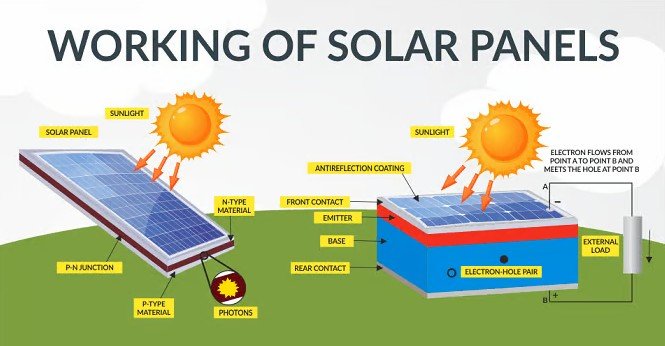
The fundamental principle behind solar panels is the photovoltaic effect. It’s a process where certain materials generate electric current when exposed to light.
A solar panel is composed of many smaller units called solar cells. These cells are typically made from silicon, a semiconductor material.
When photons from sunlight hit a solar cell, they knock electrons loose from the silicon atoms. This creates a flow of electrons, which is an electric current.
This direct current (DC) is then transmitted through wiring in the panel. Since our homes and grids use alternating current (AC), an inverter is used to convert the DC electricity from the solar panels into usable AC power.
This entire process happens with no moving parts, silently and efficiently, for decades.
Types of Solar Panels: Choosing Your Technology
The first major decision in your solar journey is selecting the type of panel technology. The three main types dominate the market today.
Mono crystalline Solar Panels
These are the premium option. They are made from single-crystal silicon, which gives them a uniform, dark black appearance.
The single-crystal structure allows for the highest efficiency rates, typically between 20% and 23%. They perform better in low-light conditions and have a longer lifespan.
This high performance comes at a cost. Mono crystalline panels are the most expensive of the three main types. They are the best choice for those with limited roof space seeking maximum power output.
Poly crystalline Solar Panels
You can identify these panels by their blue, speckled look. They are made from melted fragments of silicon crystals.
The manufacturing process is simpler and less wasteful, making them more affordable. However, their efficiency is lower, generally ranging from 15% to 17%.
They are a good budget-conscious option if you have ample roof space to accommodate more panels to meet your energy needs.
Thin-Film Solar Panels
This technology is very different. Instead of rigid silicon wafers, thin-film panels are made by depositing photovoltaic material onto a substrate like glass or metal.
They are lightweight, flexible, and have a sleek, uniform appearance. However, they have the lowest efficiency, around 10-13%, and degrade faster.
Poly Crystalline comes in in mono-facial and Mono Crystalline comes both in in mono-facial and bi-facial types of construction.
They are most commonly used in large-scale utility projects or on unconventional surfaces where weight is a major concern.
Solar Panels Efficiency Rating
Efficiency is the most cited metric when comparing solar panels. It measures what percentage of sunlight hitting the panel is converted into usable electricity.
A panel with 21% efficiency converts 21% of the solar energy it captures into electrical energy. The rest is lost as heat or reflection.
Higher efficiency means you need fewer panels to generate the same amount of power. This is crucial for roofs with limited space.
It’s important to note that efficiency is tested under ideal laboratory conditions. Real-world performance will vary based on weather, temperature, and installation angle.
Power Output and Wattage
The power output of a solar panel is measured in watts (W). It indicates the amount of power the panel can produce under standard test conditions.
Most residential panels today range from 350W to 450W. A higher wattage panel will produce more electricity than a lower wattage one in the same amount of time.
When designing a system, installers will add up the wattage of all the panels to calculate the system’s total capacity, measured in kilowatts (kW).
For example, a system with ten 400W panels has a total capacity of 4,000W, or 4 kilowatts (kW). Your energy consumption will determine the system size you need.
Temperature Coefficient
Solar panels are less efficient when they are hot. The temperature coefficient indicates how much a panel’s performance drops for every degree Celsius above 25°C (77°F).
This is a critical metric for those living in hot climates. A lower temperature coefficient is better.
For example, a coefficient of -0.35%/°C is better than -0.45%/°C. It means the panel will lose less power on a scorching summer day.
Always check the datasheet for this number. It can have a significant impact on your system’s annual energy yield.
Durability and Degradation
Solar panels are long-term investments, and their durability is paramount. They are built to withstand hail, high winds, and heavy snow loads.
Look for panels that are certified to withstand hail up to 1 inch in diameter and wind loads of up to 140 miles per hour.
More importantly, all panels slowly degrade over time, producing less power each year. The degradation rate is a key indicator of quality.
A premium panel might have a first-year degradation of 1% and then 0.4% per year thereafter. A lower-quality panel might degrade at 0.7% per year.
This difference compounds over 25 years, meaning the premium panel will be producing significantly more power at the end of its life.
Warranty Coverage
There are two types of warranties you must evaluate: the product warranty and the performance warranty.
The product warranty (or equipment warranty) covers defects in materials and workmanship. A standard warranty is 10-12 years, but premium manufacturers now offer 25-year product warranties.
The performance warranty guarantees that the panel will produce at a certain percentage of its original output after a set number of years.
A common performance warranty is 90% output after 10 years and 85% after 25 years. The best manufacturers now guarantee 92% or even higher after 25 years.
A strong, long warranty is a sign that the manufacturer stands behind the quality and longevity of its product.
Financial Evaluation: Understanding the Cost
The cost of a solar system is not just the price of the panels. It’s a complete package that includes several components.
The main costs are the panels themselves, the inverter(s), racking and mounting hardware, and the cost of labor and permits.
The total price is often quoted as a cost per watt. For example, an on grid system of Rs. 800,000 is 8 kW would have a cost of Rs. 100 per watt.
This metric allows for easy comparison between quotes from different installers. Be sure you are comparing quotes for systems of similar size and component quality.
What is an On-Grid Solar System?
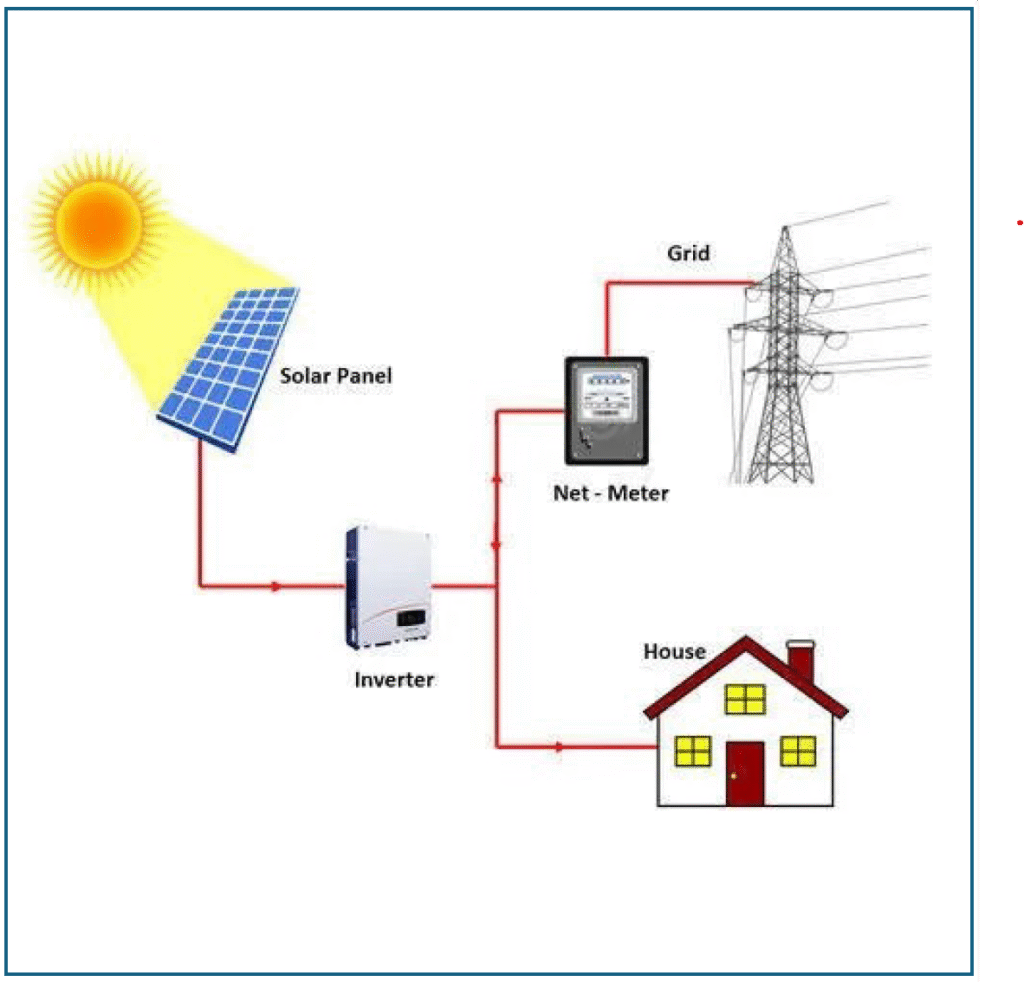
An on-grid, or grid-tied, solar system is a photovoltaic (PV) array designed to work in tandem with the public utility grid. It converts sunlight into electricity, which is first used to power your home. Any excess energy is then fed directly into the utility grid.
This interconnection allows the system to pull electricity from the grid during times of low solar production, ensuring an uninterrupted power supply. Unlike off-grid systems, this design does not require battery storage, leveraging the grid itself for backup and resulting in lower costs and higher overall efficiency.
What is a Hybrid Solar System?
A hybrid solar PV system is a combination of an on-grid and off-grid system, offering the best of both worlds. It is connected to the main public electricity grid but also uses a battery bank to store excess solar energy.
Think of it as a smart, self-reliant energy system for your home or business.
Here’s a simple breakdown of how it works:
- Powering Your Home: During the day, your solar panels generate electricity. This solar power is used first to run your appliances.
- Charging the Batteries: If your panels produce more electricity than your home is using, the excess energy is not sent to the grid immediately. Instead, it is used to charge the battery storage system.
- Using Stored Energy: When the sun goes down and your panels stop generating power, your home does not draw electricity from the grid. It automatically switches to using the clean, stored energy from your batteries.
- Interaction with the Grid: The connection to the grid serves two key purposes:
- Backup: If your batteries run out of charge (e.g., during several cloudy days), the system will seamlessly draw power from the grid to ensure you never have a blackout.
- Selling Excess: Once your batteries are fully charged, any further excess solar energy can be exported to the grid. In many regions, you may receive credits or payments for this power.
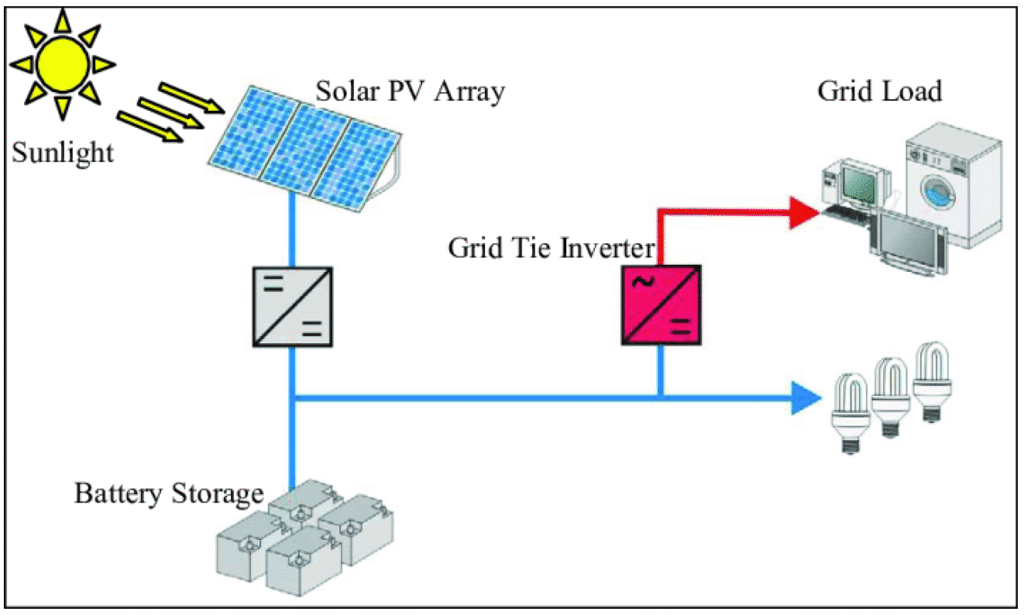
Key Component: The brain of a hybrid system is a special hybrid inverter. Unlike a standard grid-tie inverter, a hybrid inverter can manage power from the solar panels, the batteries, and the grid simultaneously, directing energy intelligently to where it’s needed most.
In short, a hybrid system prioritizes:
- Power your home with solar.
- Store extra solar energy in batteries.
- Use battery power at night.
- Use the grid only as a backup.
Financial Evaluation: Return on Investment (ROI) and Payback Period
The ultimate question for most buyers is: “When will this investment pay for itself?” This is calculated as the payback period.
To calculate it, you take the total net cost of the system (after incentives) and divide it by the annual financial benefits.
The annual benefits include the savings on your electricity bill and any income from selling solar renewable energy certificates (SRECs).
A typical payback period in the US can range from 6 to 12 years. With a system lifespan of 25+ years, that’s over a decade of virtually free electricity.
The Role of Inverters: The Brain of the System
The inverter is arguably the second most important component after the panels. Its job is to convert the DC electricity from the panels into AC electricity for your home.
There are three main types:
- String Inverters: A single inverter for the whole system. Cost-effective but if one panel is shaded, it can drag down the performance of the entire string.
- Micro-inverters: A small inverter on the back of each panel. They optimize each panel individually, so shading on one doesn’t affect the others. More expensive but offer better performance, especially on complex roofs.
- Power Optimizers: A hybrid system. Optimizers are attached to each panel (like micro-inverters) but send DC power to a central string inverter. They offer panel-level optimization at a cost between string and micro-inverter systems.
Your choice of inverter will impact your system’s efficiency, monitoring capabilities, and cost.
Installation: Choosing the Right Partner
A solar system is only as good as its installation. A poor installation can cripple the performance of even the best panels.
When evaluating installers, look for experience, proper licensing and insurance, and certifications from organizations like PEC etc.
Read online reviews and ask for references from past customers. A reputable installer will provide a detailed quote and a projected production estimate.
They should also handle all the necessary paperwork, including permits, interconnection agreements with your utility, and applications for incentives.
Conclusion: Making an Informed Solar Decision
Evaluating PV solar panels is a multi-faceted process. It requires balancing technology, cost, and trust in your installer.
Prioritize high efficiency and a low degradation rate if you have limited space and want maximum long-term output. Consider the financial metrics like cost-per-watt and payback period.
Remember, the cheapest system is not always the best value. Quality components and professional installation are worth the investment.
Harnessing the sun’s power is one of the smartest decisions you can make—for your wallet and for the planet. By using this guide, you are now equipped to ask the right questions, compare quotes intelligently, and make a confident investment in your energy future.